Launch offer — valid today only

📄 Digital book in PDF · read it on your phone or print it

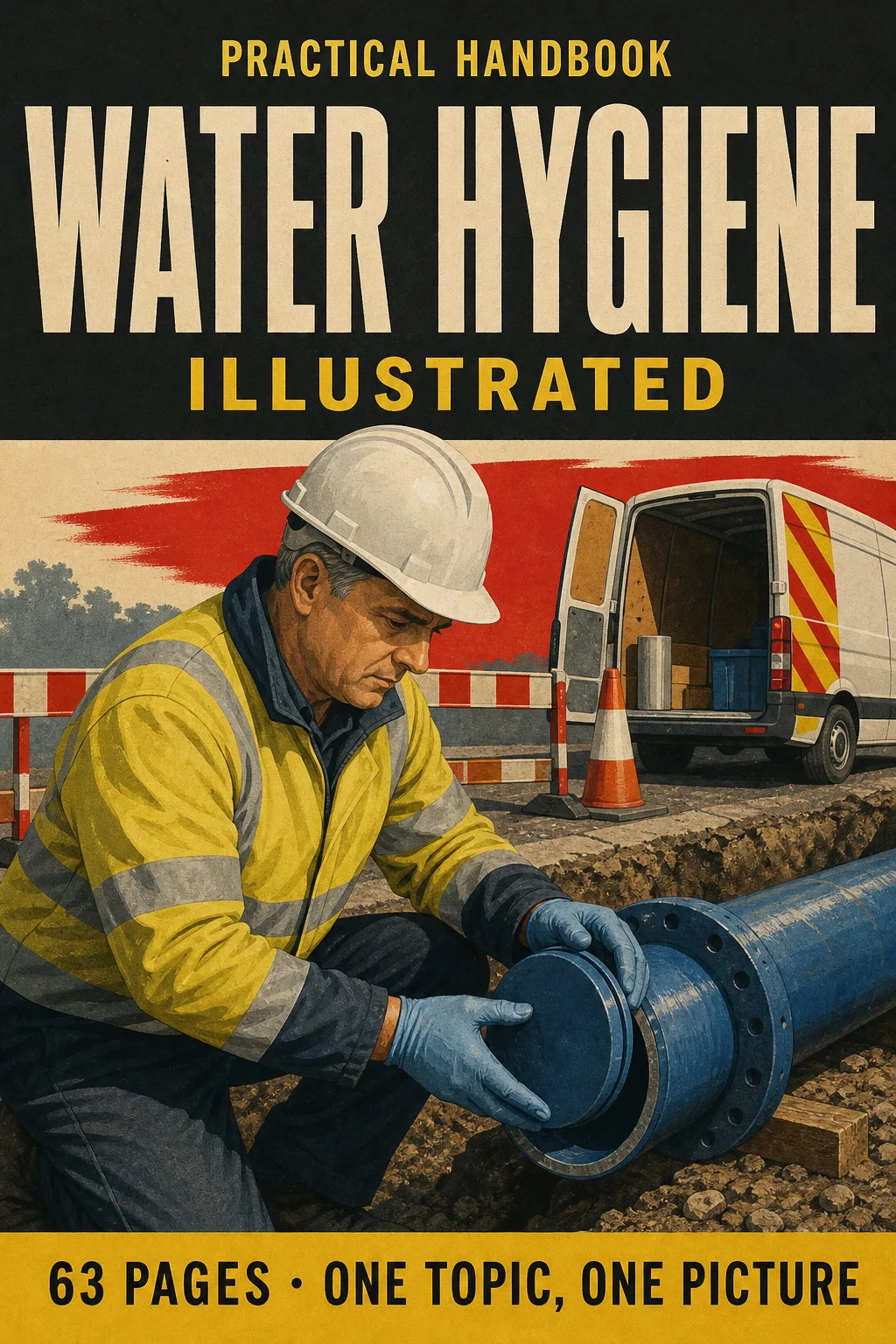
The Water Hygiene Blue Card Test in Drawings One Site Rule on Every Page

Clean and dirty zones, pipe storage, capping open ends, trench water, backflow, chlorination in mg/l, flushing, sampling and who to report to. Every topic has its own page: the drawing first, then what you need to remember. 63 illustrated pages.

START STUDYING THIS WAY

🔒 Secure checkout · PDF by email · 30-day guarantee

Every topic, its own pageEach site rule drawn, with the explanation alongside
63 illustrated pages8 parts, from the card itself to test-day revision
Up-to-date sourcesEUSR scheme information, Water UK hygiene principles and DWI guidance
PDF by emailFormat

Look Inside the Book

Every page has one big drawing and a box with the rules and numbers you need to know:

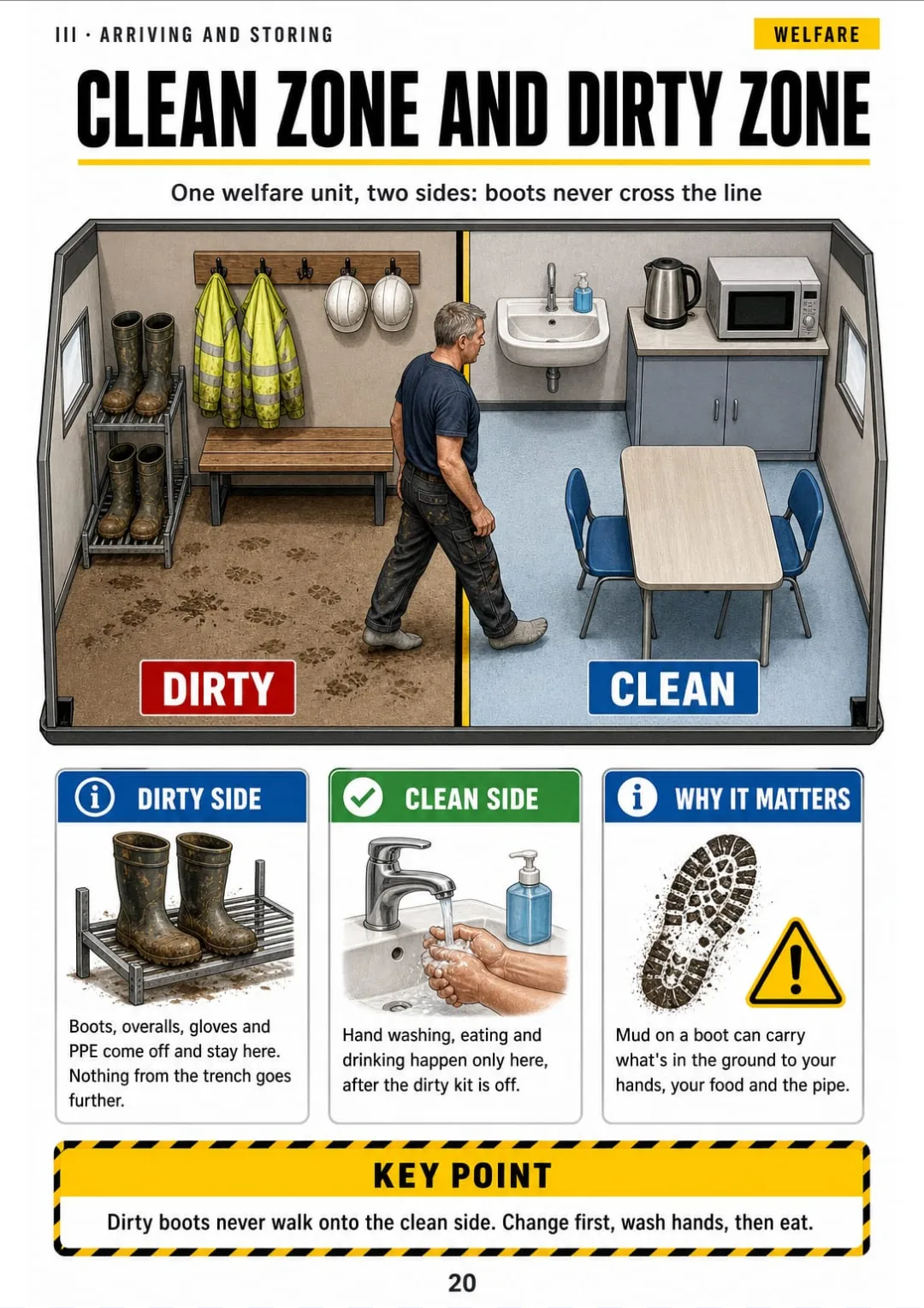
The welfare unit has two sides: dirty for boots and PPE, clean for washing and eating.
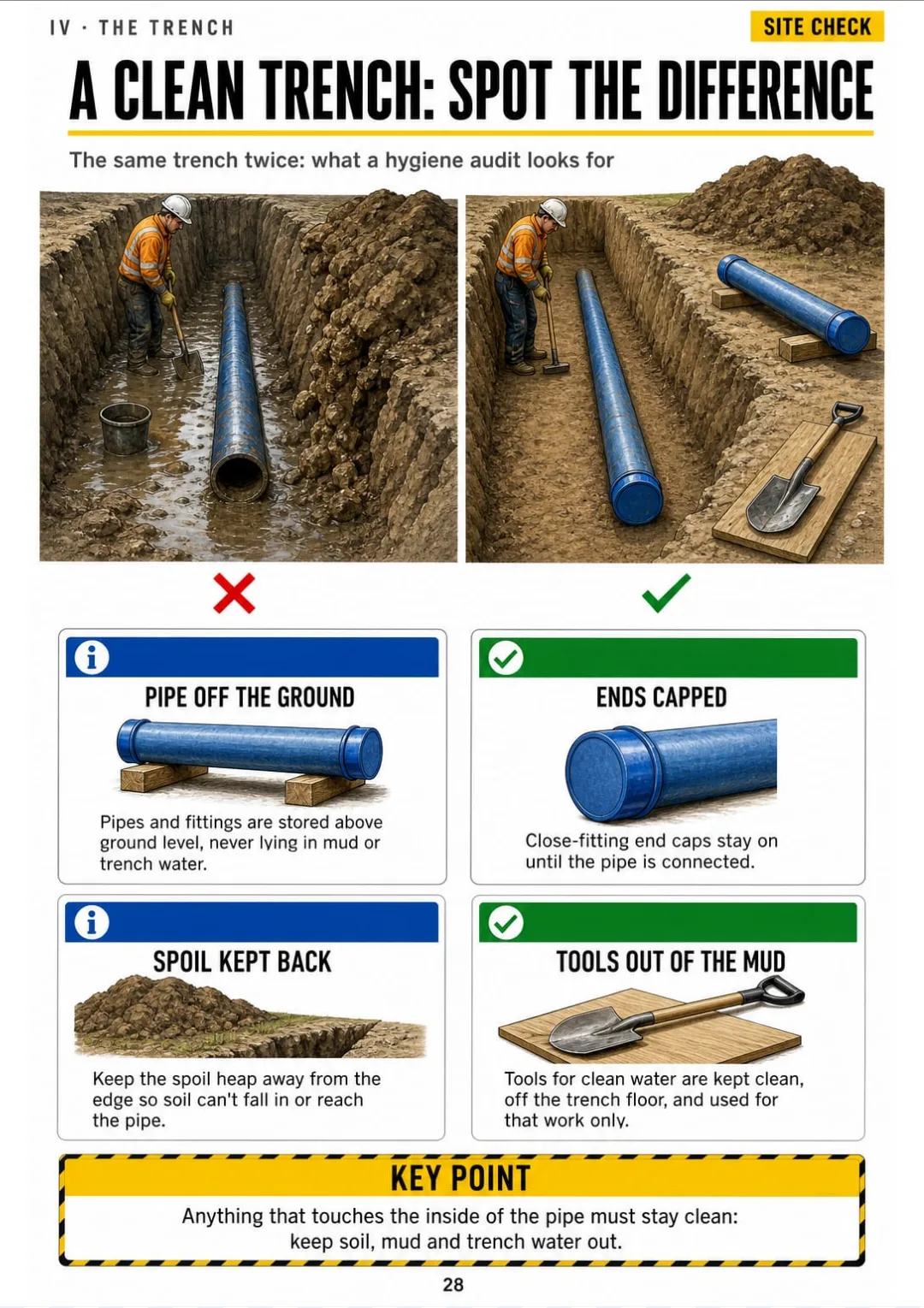
Right vs wrong trench: pipe off the ground, ends capped, spoil kept back.
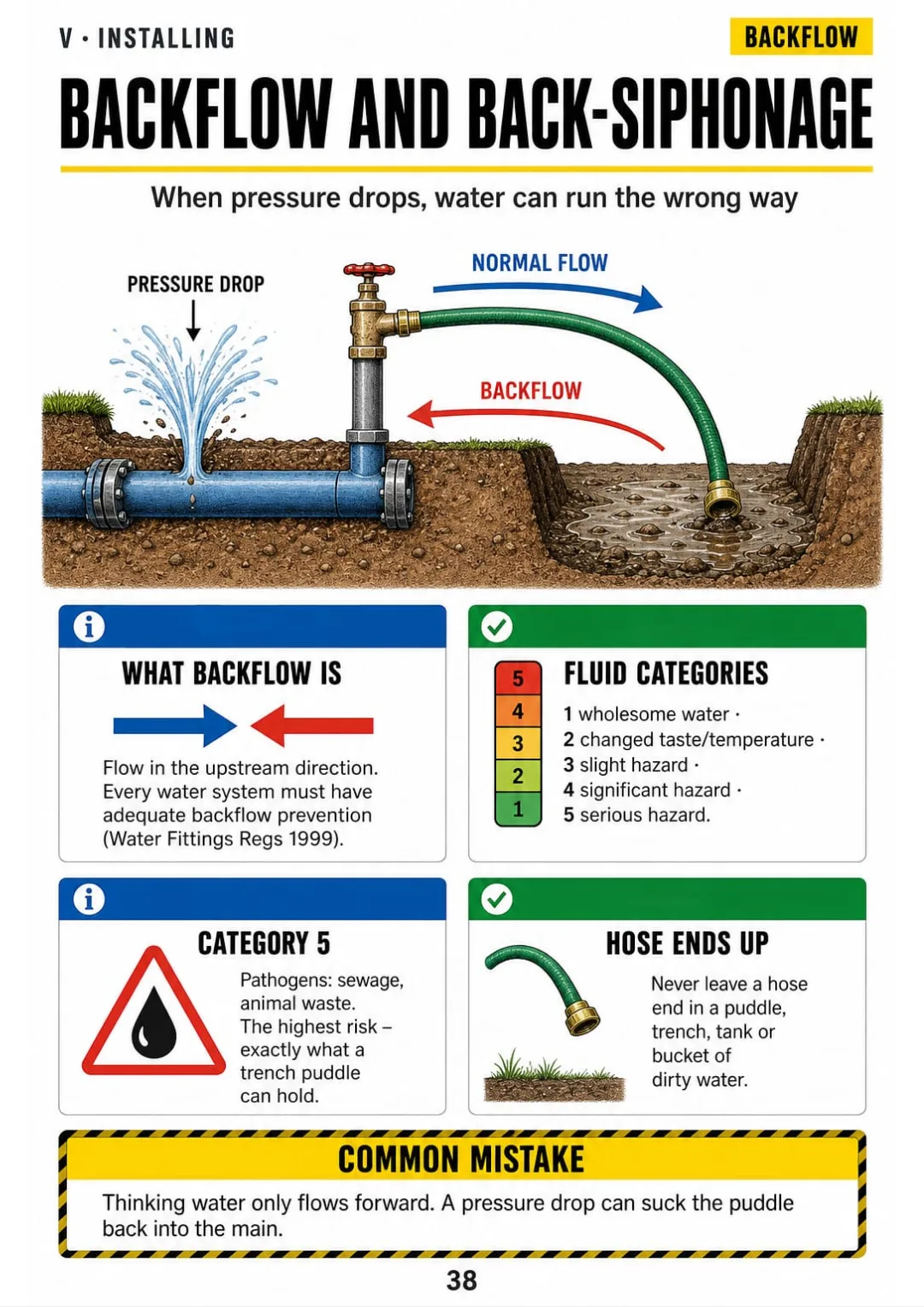
Backflow = upstream flow. Sewage is Fluid Category 5: keep hose ends out of dirty water.
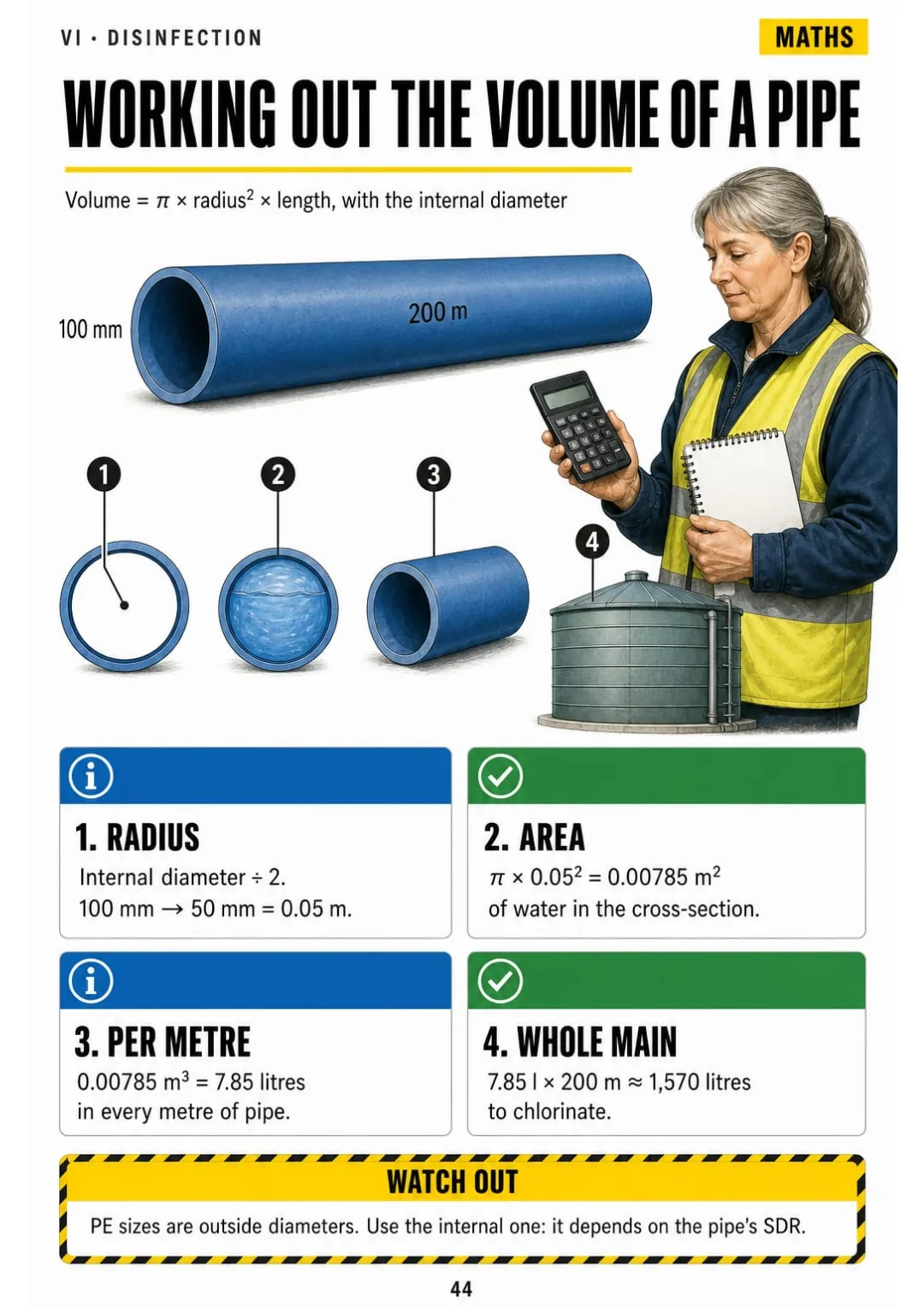
A 100 mm internal-diameter pipe holds about 7.85 litres per metre: 200 m ≈ 1,570 litres.
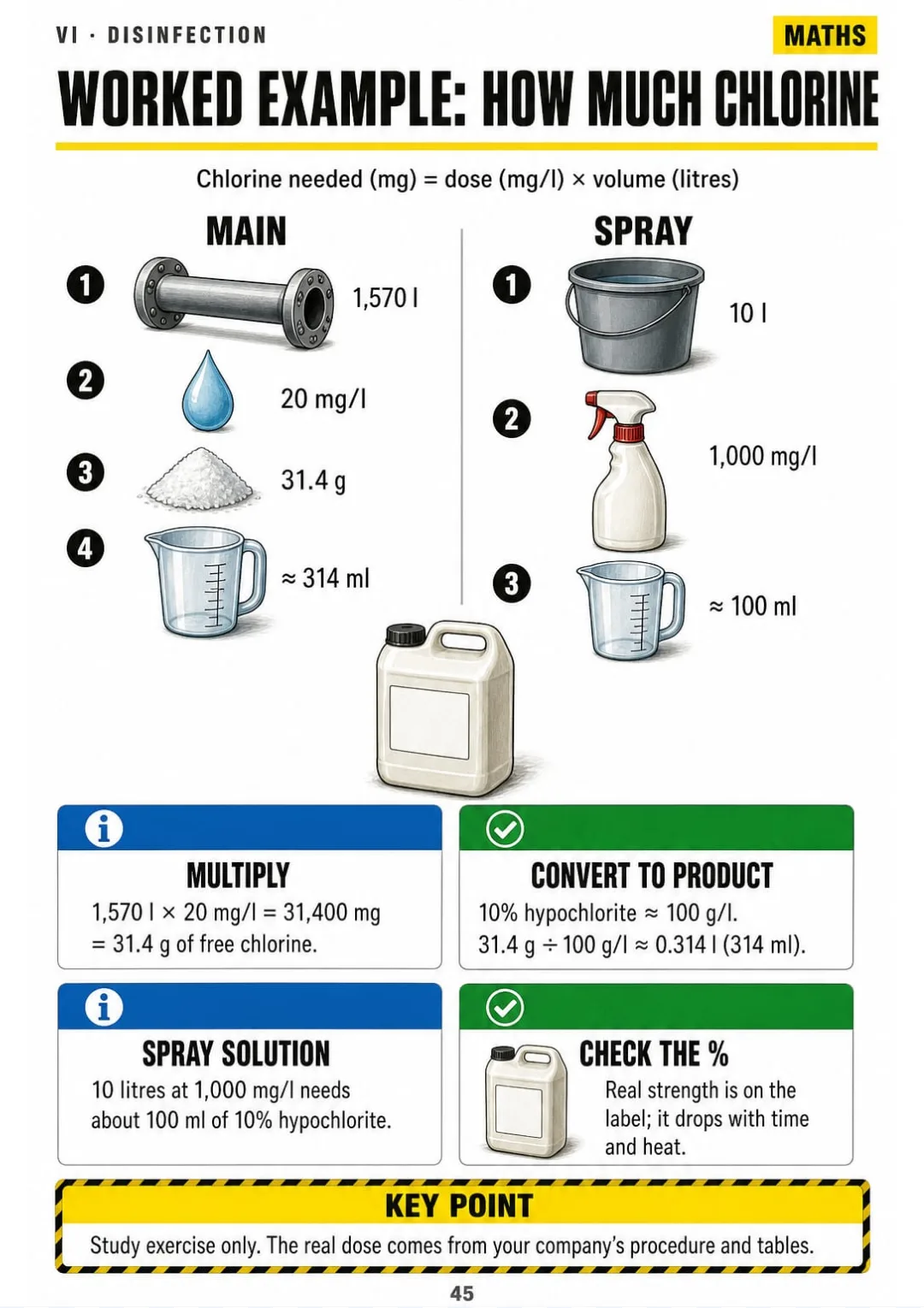
1,570 l at 20 mg/l = 31.4 g chlorine ≈ 314 ml of 10% hypochlorite (study example).
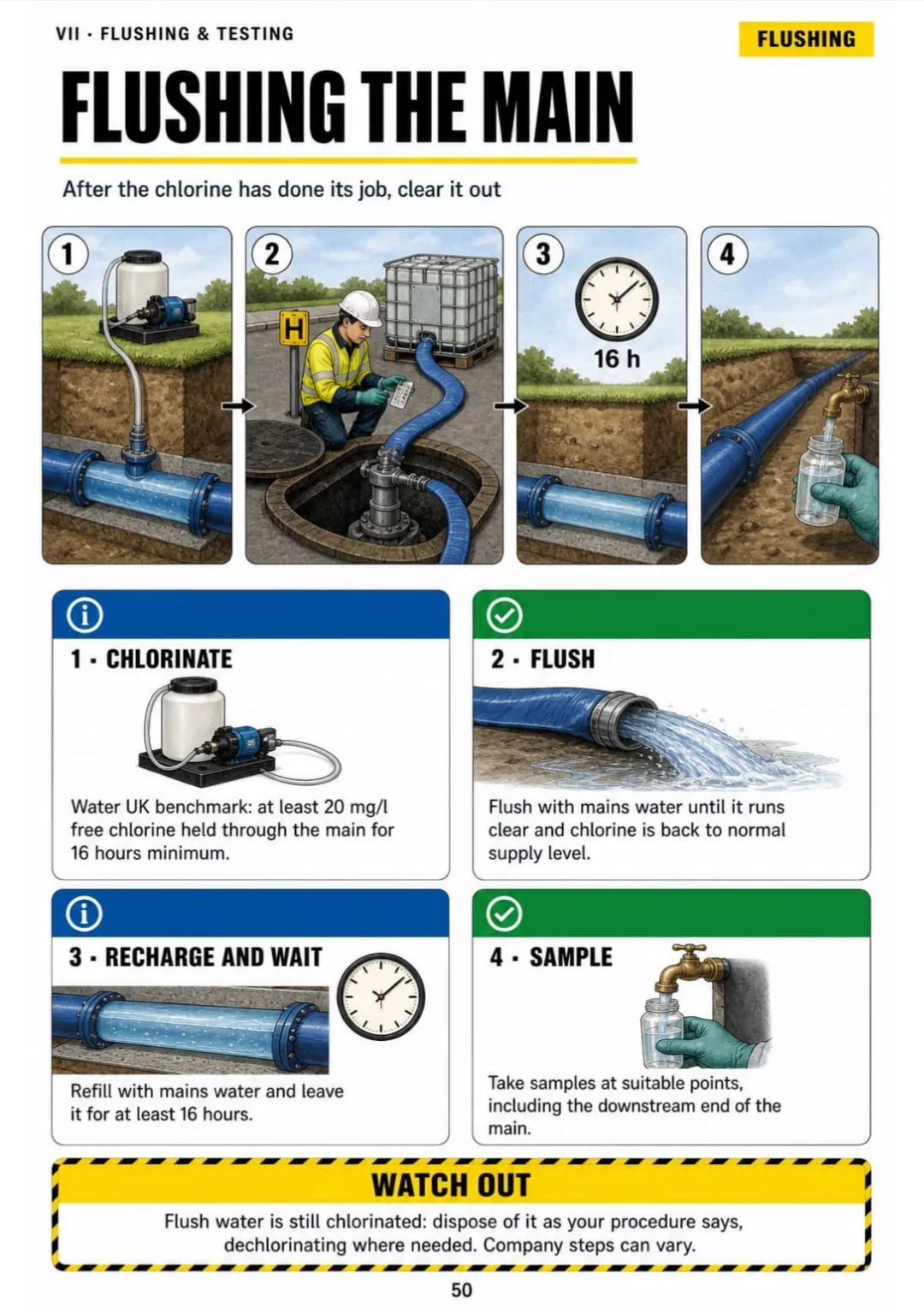
TGN 2 order: 20 mg/l for 16 h → flush until clear, chlorine at supply level → recharge 16 h → sample
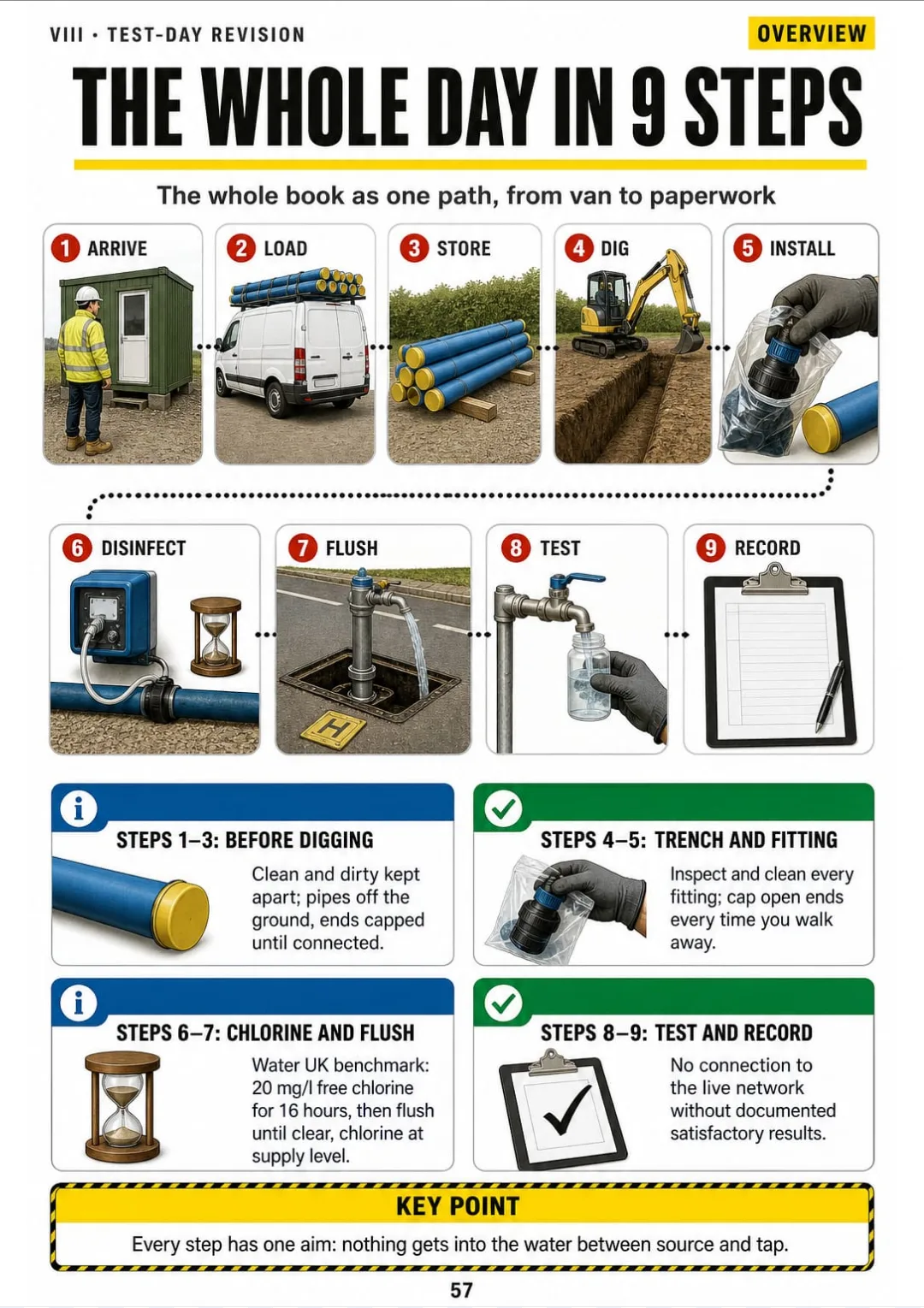
Arrive, load, store, dig, install, disinfect, flush, test, record: 9 steps on one page.
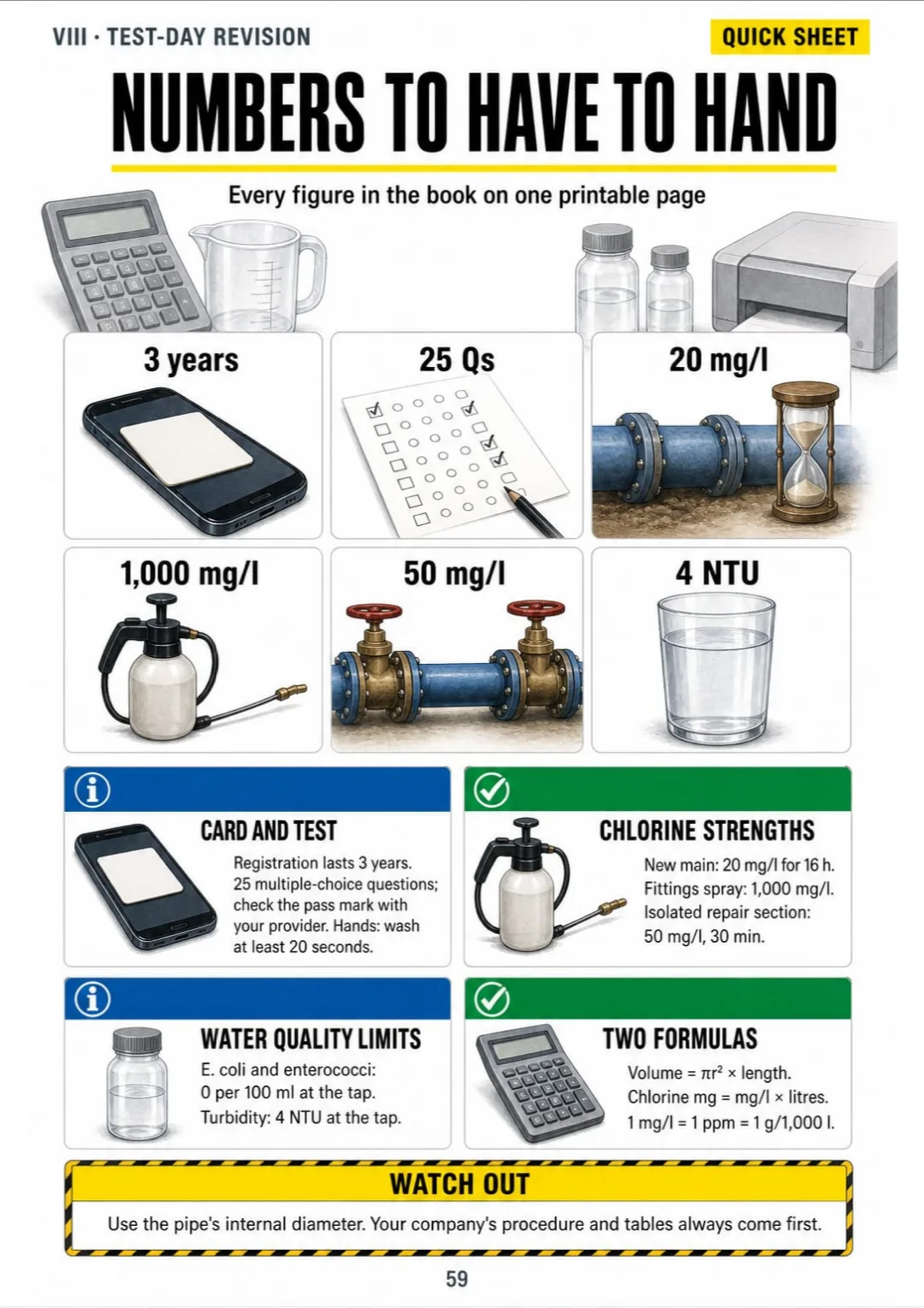
3 years, 22/25, 20 mg/l for 16 h, 1,000 mg/l, 0 E. coli, 4 NTU: all on one page.

Swipe to see more →

These are real pages from the book. The table of contents is the full one: 8 parts and 59 topics.

The Problem Isn't You. It's How It Was Explained to You.

You're filling a bowser from a standpipe and the end of the hose is lying in the water at the bottom of the excavation. The supervisor looks at it, then at you: what's the risk?

You know it's wrong. But the word won't come. The leaflet explains backflow and back-siphonage in long paragraphs, with fluid categories one to five and no picture of where the water actually goes.

Backflow = upstream flow. Sewage is Fluid Category 5: keep hose ends out of dirty water.

In the book, backflow is one page. An arrow shows the dirty water running the wrong way, back up the hose and into the main. The box says it plainly: sewage is Fluid Category 5, keep hose ends out of dirty water.

The same goes for the clean and dirty zones in the welfare, capping open ends, pipe storage, chlorination in mg/l and who to report to: each one has its own page.

You see why the rule exists, and you do it right on site without going back to the leaflet. On the test, the question reads like a job you've already done.

COMPARE FOR YOURSELF

Same Topic, Two Ways to Study It

THIS
  • The leaflet: line after line of text
  • Trench hygiene explained only in words
  • You walk into the test with doubts
Excavations in which pipework for the conveyance of water intended for human consumption is to be laid shall be maintained in a condition such that the ingress of contaminants into the pipe bore is prevented at all times. Pipes and fittings shall not be placed in direct contact with the trench floor or with standing water, and all open ends shall be sealed by means of appropriate caps whenever work is not in progress. Excavated material shall be positioned at a sufficient distance from the trench edge to prevent its migration into the excavation.
FOR THIS
  • A clean trench in one drawing
  • The rules in one box
  • You see it and you get it
Right vs wrong trench: pipe off the ground, ends capped, spoil kept back.
CONTENTS

Take a Look at the 8 Parts and 59 Topics

The card, your health, arriving and storing, the trench, installing, chlorination, flushing and reporting, and test-day revision: 63 pages, all illustrated.

IThe Card and Why It Exists · pp. 5-12
  1. What the National Water Hygiene card is
  2. Who needs the card
  3. How the course and the test work
  4. From source to tap: one single path
  5. What can get into the water
  6. The bugs that make people ill
  7. Who checks the water
  8. Why one mistake costs so much
IIYou and Your Health · pp. 13-19
  1. The health screening questionnaire
  2. Diarrhoea and vomiting: stop and report
  3. Illness at home and after travel
  4. Hand washing that actually works
  5. Cuts, sores and gloves
  6. Sewers and clean water: never mixed
  7. Food, drink and smoking on site
IIIArriving, Loading and Storing · pp. 20-27
  1. Clean zone and dirty zone in the welfare
  2. The van: what goes where
  3. Dedicated tools for clean water
  4. Pipe storage: off the ground, ends capped
  5. Fittings stay bagged until used
  6. PE pipe and contaminated ground
  7. Fuel, oil and chemicals
  8. Checking materials on delivery
IVThe Trench and Open Mains · pp. 28-34
  1. A clean trench: before and after
  2. Trench water and pumping
  3. Capping open ends every time
  4. If an open main gets contaminated
  5. Sewers and drains close by
  6. Animals, birds and vermin
  7. Weather, rain and flooding
VInstalling and Connecting · pp. 35-41
  1. Inspect and clean before you fit
  2. Spraying fittings with chlorine solution
  3. Connecting to a live main
  4. Backflow and back-siphonage
  5. Standpipes and hydrants
  6. Hoses for drinking water
  7. Service pipes and meters
VIDisinfection and Chlorination · pp. 42-49
  1. Why we chlorinate a new main
  2. What mg/l means
  3. Working out the volume of a pipe
  4. Worked example: how much chlorine
  5. Contact time
  6. Checking the chlorine residual
  7. Handling sodium hypochlorite safely
  8. Getting rid of chlorinated water
VIIFlushing, Testing and Reporting · pp. 50-56
  1. Flushing the main
  2. Taking samples
  3. What a sample checks
  4. Bringing a main into service
  5. Records and paperwork
  6. Who to report to, and when
  7. Customer complaints you might hear
VIIITest-Day Revision · pp. 57-63
  1. The whole day in 9 steps
  2. Clean or dirty? Spot the difference
  3. Numbers to have to hand
  4. The most frequent mistakes
  5. Multiple-choice: how to read the question
  6. Words you'll hear on the course
  7. The night before and the day itself

One Page, One Topic, All Clear

Think of it this way:

You're on a new main with the gang: 100 mm, 200 metres, ready to charge. How much water is in there, and how much chlorine takes it to 20 mg/l?

In the book you open the volume page and the pipe is drawn cut open: 100 mm inside, about 7.85 litres per metre, 200 metres ≈ 1,570 litres. Turn the page and the worked example takes you to grams of chlorine, one step at a time.

1,570 l at 20 mg/l = 31.4 g chlorine ≈ 314 ml of 10% hypochlorite (study example).

Same with the clean and dirty zones in the welfare, pipe stored off the ground, capping open ends, backflow and flushing the main: each one on its own page.

Water Hygiene Illustrated is 8 parts and 59 topics, all drawn, and at the end a test-day revision part with the whole day in 9 steps and the numbers to have to hand.

What you see drawn, you don't have to memorize.

What's Inside Water Hygiene Illustrated:

Ipp. 5-12

The Card and Why It Exists

What the card is, who needs it, how the course and test work, the path from source to tap, what can get into the water and who checks it.

IIpp. 13-19

You and Your Health

The health questionnaire, when to stop and report, illness after travel, proper hand washing, cuts and gloves, and food, drink and smoking on site.

IIIpp. 20-27

Arriving, Loading and Storing

Clean and dirty zones in the welfare, what goes where in the van, dedicated tools, pipe storage, bagged fittings, fuel and chemicals, and checking deliveries.

IVpp. 28-34

The Trench and Open Mains

A clean trench before and after, trench water and pumping, capping open ends, contaminated mains, sewers close by, animals and bad weather.

Vpp. 35-41

Installing and Connecting

Inspecting and cleaning fittings, chlorine spraying, connecting to a live main, backflow, standpipes and hydrants, drinking-water hoses, service pipes and meters.

VIpp. 42-49

Disinfection and Chlorination

Why we chlorinate, what mg/l means, pipe volume, a worked chlorine example, contact time, residuals, handling hypochlorite and getting rid of chlorinated water.

VIIpp. 50-56

Flushing, Testing and Reporting

Flushing the main, taking samples, what they check, bringing a main into service, records, who to report to and the complaints you might hear.

VIIIpp. 57-63

Test-Day Revision

The whole day in 9 steps, clean or dirty spot-the-difference, the numbers to have to hand, the most frequent mistakes and how to read a multiple-choice question.

At the end of the book: A test-day revision part: the whole day in 9 steps, the numbers to have to hand and how to read a multiple-choice question.
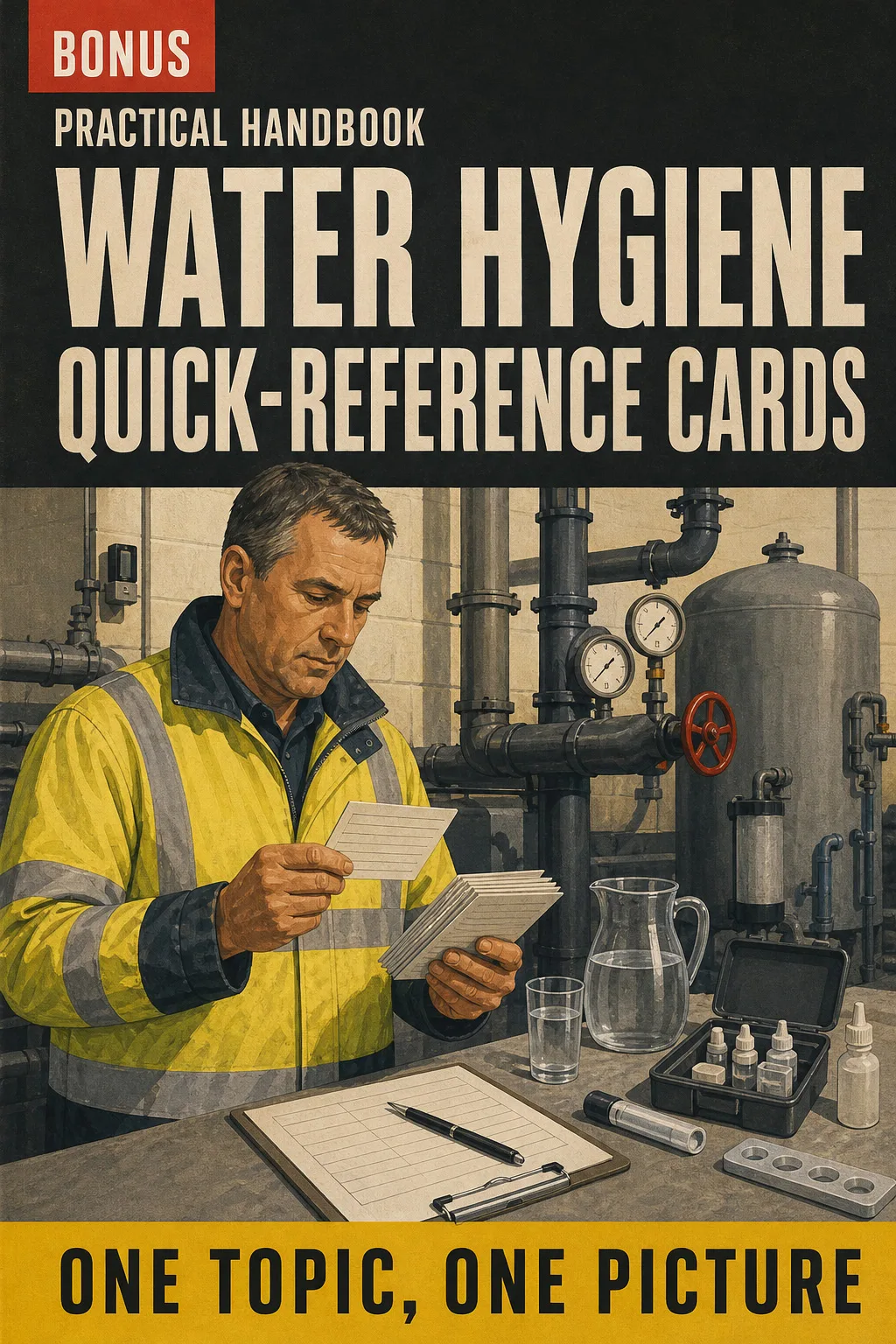
Plus: 2 Free Books

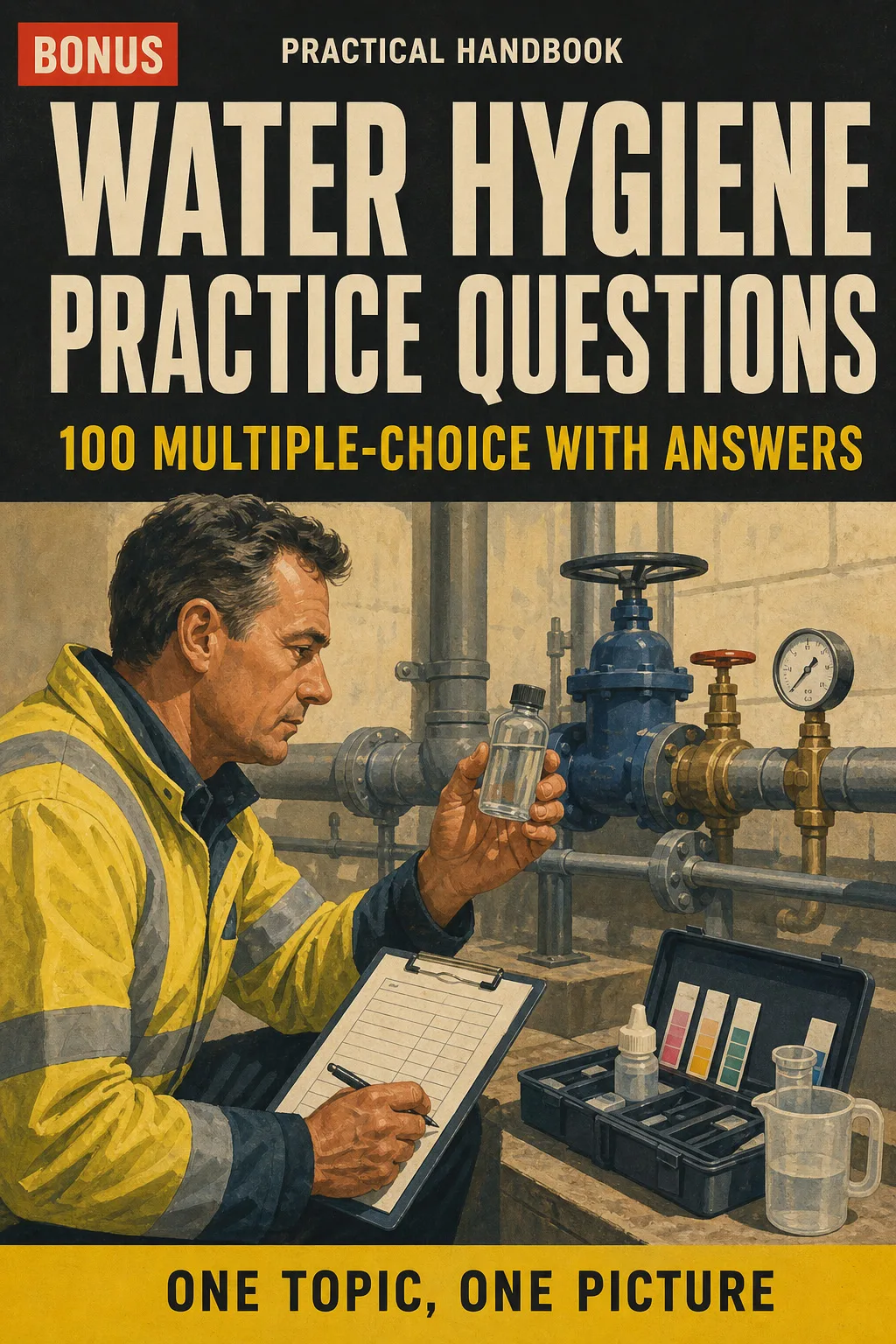
Water Hygiene Practice Questions: 100 Multiple-Choice with Answers

BONUS 1: «Water Hygiene Practice Questions: 100 Multiple-Choice with Answers»

Value on its own: US$ 17.90

Practise in the same multiple-choice style as the test, with a short explanation of why each answer is right, so nothing on the day feels new.

Water Hygiene Quick-Reference Cards

BONUS 2: «Water Hygiene Quick-Reference Cards»

Value on its own: US$ 14.90

The rules you need to have to hand, on printable cards: clean zones, capping, storage off the ground, chlorination steps and who to call. Ideal for a last look the night before.

Water Hygiene Illustrated with 2 Free Books

  • Water Hygiene Illustrated: 63 illustrated pagesUS$ 63
  • BONUS 1: Water Hygiene Practice Questions: 100 Multiple-Choice with AnswersUS$ 17.90
  • BONUS 2: Water Hygiene Quick-Reference CardsUS$ 14.90
  • High-resolution PDF to printIncluded
Total value US$ 95.80
YOUR PRICE:
US$ 27
You save US$ 68.80
YES, I WANT WATER HYGIENE ILLUSTRATED FOR US$ 27

📄 This is a digital PDF book sent to your email: nothing is printed or shipped.

Secure purchaseEncrypted payment30-day guarantee

PDF by email: We email you Water Hygiene Illustrated as a PDF, together with the two free books. It's a single payment: no installments, no extra charges.

Who This Book Is For

Getting your card for the first time

Getting your card for the first time

You see each rule as a site drawing, in the order you work, so the course makes sense from the first hour.

Your renewal's coming up

Your renewal's coming up

A quick, clear read the week before, with the numbers on one page and 100 practice questions to try the multiple-choice style.

Already on the mains every day

Already on the mains every day

Printed and kept in the van, it's there when you need to check capping, chlorination steps or who to call.

Everything You Get Today

US$ 95.80US$ 27
YES, I WANT WATER HYGIENE ILLUSTRATED FOR US$ 27

📄 This is a digital PDF book sent to your email: nothing is printed or shipped.

30DAYS
GUARANTEE

30-Day Guarantee

Try Water Hygiene Illustrated for 30 days, bonus books included.

We refund everything if the file won't open, if the book isn't what you see here, if you were charged twice or if the email doesn't arrive. Just email us.

You pay once. No subscriptions.

Frequently Asked Questions

Is it for me if I've done this job for years and haven't sat a written test since school?

Yes. It isn't a beginner's book: it follows the job you already do, with short sentences, large print and one drawing per topic.

Where does the content come from?

It's written for the UK National Water Hygiene card (the EUSR 'Blue Card'), not a generic hygiene course. The content comes from current EUSR scheme information, Water UK's Principles of Water Supply Hygiene, the drinking water quality regulations and DWI guidance. Always check the details of your course with your trainer.

Is it official material?

No. It's an independent study guide, not affiliated with or endorsed by EUSR, Energy & Utility Skills or any water company.

Does it replace the course?

No. It doesn't give you a card or a certificate: the Blue Card only comes from passing the approved National Water Hygiene course and test. The book helps you prepare and revise. For health questions, follow your employer's occupational health advice.

Are the practice questions the ones on the test?

No. They're written for this book, in the same multiple-choice style, with a short explanation of each answer.

When and how does it arrive?

As a PDF by email, to the address you enter at checkout. The two free books come the same way.

Do I have to pay every month?

No. It's a one-off payment.

Can I have it on paper?

Yes. Print it at home or at a print shop and keep it in the van.

How does the refund work?

You have 30 days. We refund everything if the file won't open, if the book isn't what you see on this page, if you were charged twice or if the email doesn't arrive: just email us.

Before You Close This Page

No more rereading the leaflet with nothing sticking.

Backflow, capping and chlorination: you see them drawn, and that's it.

You walk into the test knowing where everything is.

Drawings make studying faster.

The book is right below.

One-time payment: US$ 27 · Guarantee: 30 days · PDF by email

YES, I WANT WATER HYGIENE ILLUSTRATED FOR US$ 27

📄 This is a digital PDF book sent to your email: nothing is printed or shipped.